sunflower

Sunflower, the floral equivalent of a happy face, is a daisy-shaped flower, consisting of yellow petals extending from a large dark center. Sunflowers are very popular cut flowers that are available year-round. Flower colors include yellow, red, brown, and orange.

sunflower

What are sunflowers?

Sunflowers are useful plants with large flower heads, or blooms. They are named for the way they turn their blooms from east to west to follow the Sun. Sunflowers were first grown in North and South America. Today they are also grown in other parts of the world, including Europe and Asia.
Sunflowers are giants among flowers. The rough, hairy stem grows from 3 to 15 feet (1 to 4.5 meters) tall. The leaves are wide, rough, and 3 to 12 inches (8 to 30 centimeters) long.
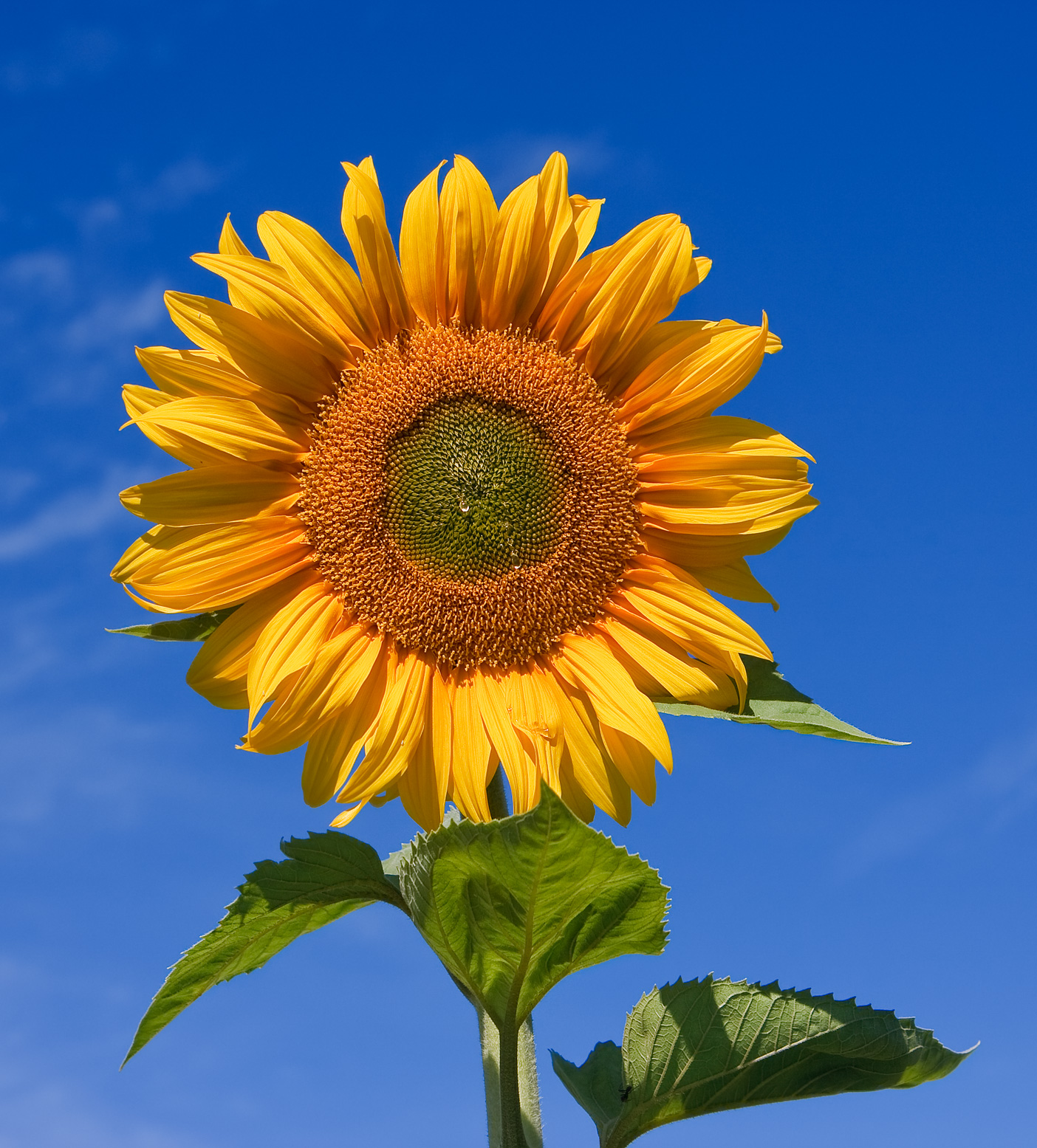
The bloom of a sunflower has two parts. The center is a disk of small flowers packed closely together. The disk flowers are brown, yellow, or purple. The flowers around the outside are called ray flowers. They are golden yellow.
Some sunflowers have disks that are 12 inches (30 centimeters) wide.Sunflower plants have many uses. The flowers make a yellow dye. The leaves are used to feed animals.
Seeds that come from the disk flowers contain a sweet, yellow oil. Sunflower oil is used in cooking and in making soaps and paints. Many people eat dried or roasted sunflower seeds as a snack.
Seed to harvest:
The stages of the sunflower life cycle

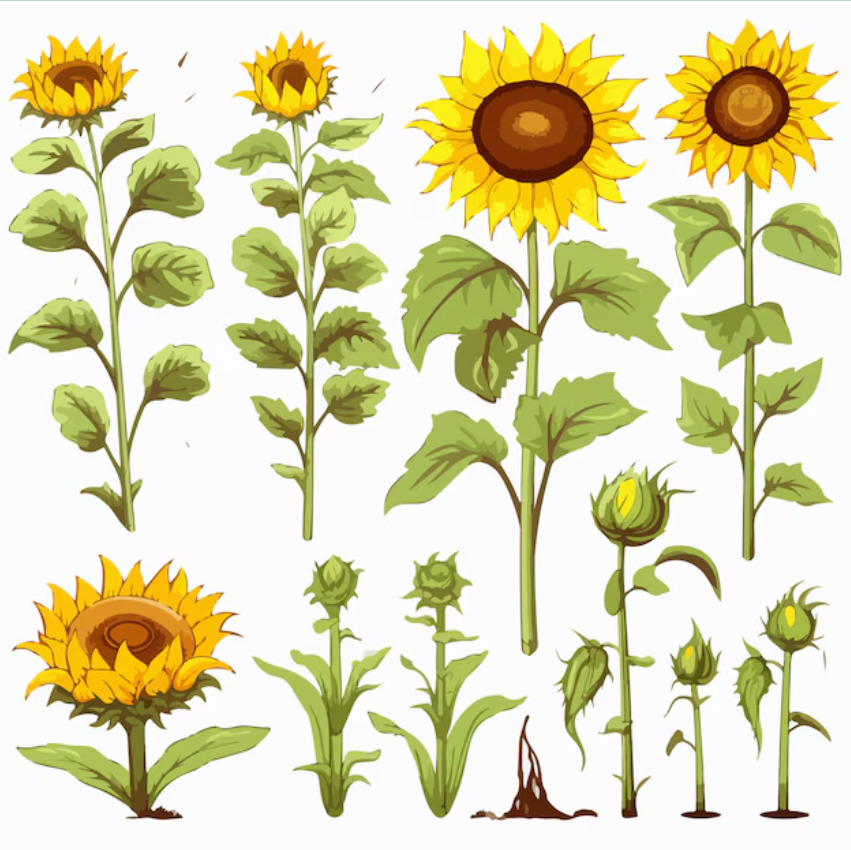
The sunflower life cycle consists of many stages. First, a seed is planted in the soil. Then, after a couple of weeks,the first green shoots of a young sunflower will rise up from the ground.
Slowly but surely, the tiny plant will grow leaves, a bud, and eventually - after roughly three months - a golden flower. But that's not the end of the sunflower's story, not by a long shot.
Let's take a look at the sunflower life cycle in a bit more detail, and discover what happens after a sunflower blooms...
sunflower lifecycle

  • Seed

    • One day.
    • The sunflower life cycle begins with a seed.
  • Germination

    • One week after planting.
    • Soon after they're planted, sunflower seeds start absorbing moisture through their shells. As they soak up more and more water, their shells begin to crack open, as they're unable to contain the extra moisture. The sunflower's roots emerge first - their role is to stabilize the plant and absorb vital nutrients from the soil.
  • Seedling

    • Two to five weeks after planting.
    • Once the roots have absorbed plenty of water, a small shoot will make its way out of the ground. This tiny plant - known as a “seedling” - is made up of a thin stem and two leaves.
    • During this stage, as the stem grows taller and taller, the plant will grow many more leaves. The fledgling sunflower uses its leaves to absorb sunlight, which it turns into food via photosynthesis.
    • Seedlings are extremely vulnerable to environmental factors, such as extreme temperatures (high and low), lack of water, and insects.
  • Bud

    • Five to 10 weeks after planting.
    • Also known as the “reproductive phase,” this stage is when a small bud develops at the tip of the stem. At first, the bud will be closed, but over time it will open up to display the bright golden petals within.
    • Did you know that, during the reproductive phase, sunflowers physically move towards sunlight? It's true - as the sun drifts across the sky, sunflowers will change position to make sure they're getting as much sunlight as possible. This behavior - known as heliotropism - is how sunflowers got their name.
  • Full bloom

    • 10 to 13 weeks after planting.
    • After two to three months, sunflowers begin to flower. Typically, sunflowers stay in bloom for three weeks, but you might get a full month if you're lucky.
    • At this stage, sunflowers are like a shining beacon for bees, butterflies, beetles, and a whole host of other pint-sized pollinators. Attracted by the vibrant petals, these insects come to drink nectar from the center of the sunflower.
    • In the process, their furry bodies pick up pollen from the male part of the plant (known as anthers), which they carry to the next plant. There, the bees deposit the pollen onto the female parts of the flower (known as stigma), which fertilizes the plant and ensures that it'll produce fruit and seeds in the future.
  • Wilt

    • 13 to 15 weeks after planting.
    • All good things must come to an end. At 13 to 15 weeks, the petals turn from bright yellow to rusty brown, and the head of the sunflower starts to droop.
  • Regeneration, or harvest

    • 15 to 17 weeks after planting.
    • During the regeneration (or reproduction) stage, the sunflower withers completely, shedding its seeds on the soil below. Some will embed themselves in the ground, some will scatter on the breeze, while others will be eaten by birds and squirrels. This process - known as seed dispersal - allows the sunflower life cycle to begin all over again.

gallary

Helianthus is a genus comprising around 70 species of annual and perennial flowering plants in the daisy family Asteraceae commonly known as sunflowers. Except for three South American species, the species of Helianthus are native to North America and Central America. The best-known species is the common sunflower.

Common sunflower

The common sunflower is a species of large annual forb of the daisy family Asteraceae. The common sunflower is harvested for its edible oily seeds, which are often eaten as a snack food.

Perennial sunflower

Perennial sunflower is a crop of sunflowers that are developed by crossing wild perennial and domestic annual sunflower species. Annual sunflower is a major oilseed crop. Genes from wild perennial relatives may increase root depth and mass and extend the growing season.

Helianthus debilis

Helianthus debilis is a species of sunflower known by the common names cucumberleaf sunflower, beach sunflower, weak sunflower, and East Coast dune sunflower. It is native to the United States, where it can be found along the Atlantic and Gulf Coasts.

Helianthus pauciflorus

Helianthus pauciflorus, called the stiff sunflower, is a North American plant species in the family Asteraceae. It is widespread across the Great Plains, the Rocky Mountains, and the Great Lakes region, and naturalized in scattered locations in the eastern United States and in much of southern Canada.

Helianthus paradoxus

Helianthus paradoxus, the paradox sunflower, puzzle sunflower or Pecos sunflower, is a threatened species of sunflower found only in west Texas, Utah, and New Mexico salt marshes by the edges of inland salt lakes and salt flats.

Helianthus ciliaris

Helianthus ciliaris is a species of sunflower known by the common names Texas blueweed and yerba parda. Helianthus ciliaris grows in much of the south-central and southwestern United States and northern Mexico, but it can be found elsewhere in North America where it is an introduced species and often a noxious weed.

Join Us

Subscribe to our newsletter, please register your email to follow up: